
Gate Operators and Openers
The motors that move slide, swing, underground and barrier gates, and the sensors and controls that tell them when to stop.
An operator is the motor, drive and control board that opens and closes a gate on command, from a keypad, a remote or a phone. We repair automatic gates and replace sliding and swing gate operators that have worn out or no longer suit the gate they move.
Choosing one starts with the gate: how it moves, how heavy and long it is, and how many times a day it cycles. A backyard swing gate and a busy HOA entrance need very different machines.
Slide, Swing, Underground and Barrier Operators

A slide operator sits beside the opening and drives the gate with a chain or a gear rack. A cantilever gate rides on rollers at one side and never touches the ground across the opening, so there is no track to clog, which suits long gates on commercial lots.
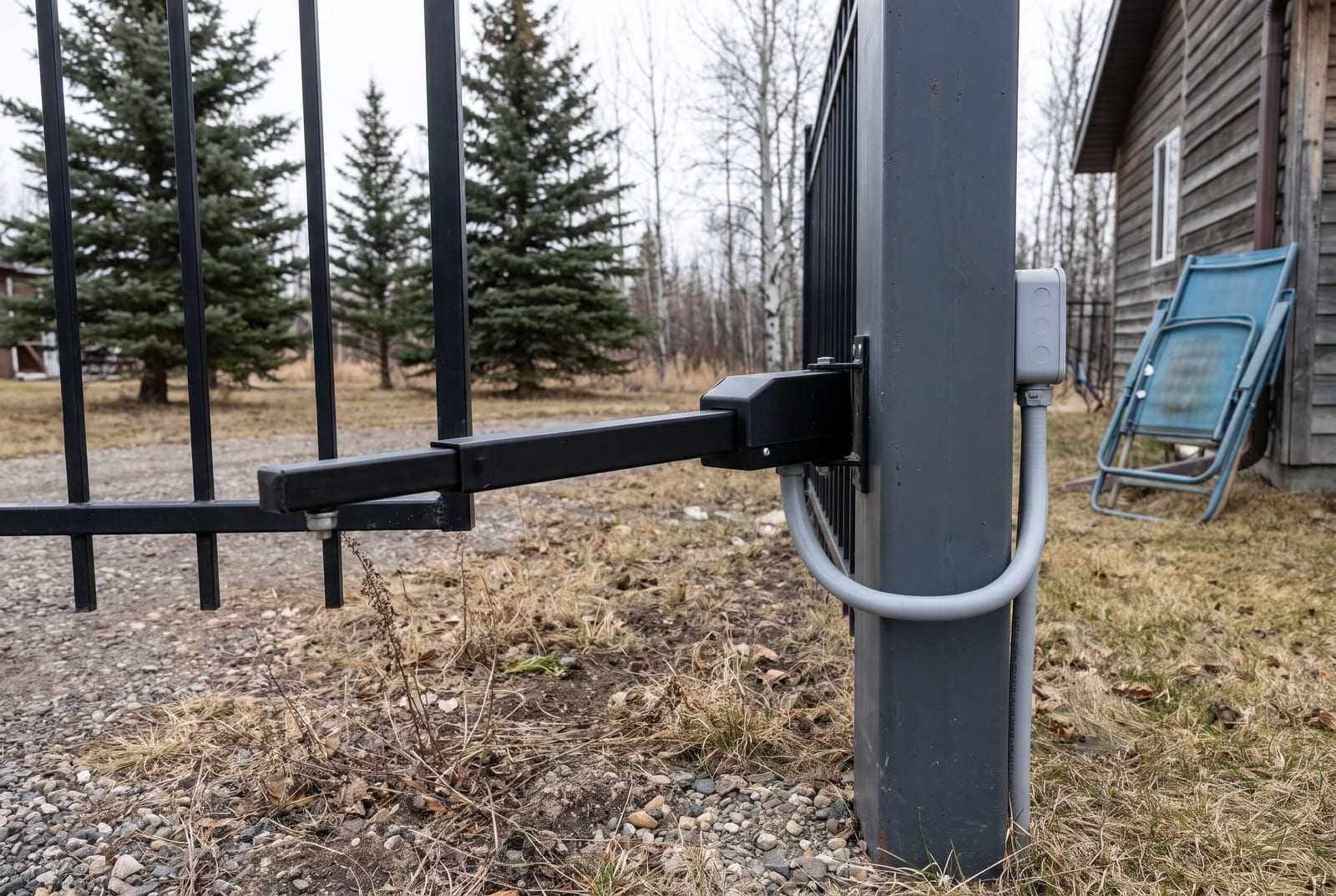
Swing operators push and pull a hinged leaf with an arm or a linear drive mounted on the post, one per leaf on a double gate. They suit most residential driveway and backyard gates, as long as each leaf has room to swing clear.
| Operator type | Gate it suits | Power options | Notes |
|---|---|---|---|
| Slide | Sliding and cantilever gates that roll across the opening, often on wide driveways and commercial lots | Mains; solar on lighter gates with few daily cycles; battery backup | Needs a clear run beside the opening as long as the gate, and a ground track that stays clear |
| Swing | Single and double swing gates on hinges, from backyard gates to driveway pairs | Mains; solar on lighter residential gates; battery backup | Arm or linear drives mount on the post; each leaf needs room to swing clear of slopes, cars and plants |
| Underground | Swing gates where a post-mounted arm would spoil the look or get in the way | Mains, usually with battery backup | The motor sits in a buried box under the hinge, so the box has to drain well |
| Barrier arm | Entry and exit lanes at apartment complexes, HOA entrances and commercial lots | Mains, with battery backup on busy lanes | Lifts an arm instead of moving a gate; quick cycles suit heavy traffic, but it does not stop people on foot |
Whichever type moves the gate, it takes its commands from the same places: keypads, remotes and intercoms, and on more gates now, a phone app.
Safety Devices on an Automatic Gate
An operator moves hundreds of pounds of steel on its own, so it has to know when to stop. These are the features to expect on any automatic gate in daily use:
- Photo eyes: an infrared beam across the gate’s path that stops or reverses the gate when anything breaks it
- Reverse on contact: edge sensors and the operator’s own obstruction sensing, which back the gate off when it meets resistance
- Manual release: a lever, key or knob that disconnects the operator so the gate can be moved by hand when the power is out
- Limit settings: set stops at fully open and fully closed, so the gate travels its full distance without straining or overrunning
A gate that no longer reverses, or reverses with nothing in the way, should come out of daily use until it is repaired. Often the cause is a dirty sensor, a loose wire or a setting rather than a failed operator.
Operator Faults and Power Choices
Why is my gate operator not responding?
Check the power first: a tripped breaker, a switched-off control box or a dead backup battery stops everything. With power on, a blocked or misaligned photo eye can keep the gate from closing, and a manual release left engaged lets the motor run while the gate stays put. A failed control board, receiver or capacitor is next on the list, and that is work for a technician.
Why is my gate moving slowly or making noise?
Slow travel often comes from a weak battery, a gate binding on a worn hinge or roller, or a chain that has stretched. Grinding, squealing and clanking point to dry or worn rollers, bearings or gears. On cold Denver mornings, thickened grease and a chilled battery slow almost any operator, so a gate that is only slow in winter may need cleaning and fresh lubricant more than new parts.
Is solar or mains power better for a gate operator?
Mains power suits heavy gates, busy entrances and control boxes that also run lights or an intercom. Solar works well on lighter gates that open a handful of times a day, or where running a power line would mean a long trench, and Denver’s strong sun helps. The panel needs a clear view of the sky, though, and short winter days and cold weather cut what its battery can store.
Worn-Out Operators
An operator that keeps failing, strains on every cycle or needs parts that are no longer made is close to the end of its life. So is one that was undersized for its gate from the start.
Replacing it is a chance to match the operator to how the gate is used now, battery backup included. When the gate itself is worn out too, it can make sense to replace the gate and the operator together.
A photo of the operator’s label and control box, sent before the first visit, helps the right parts come along. Call (720) 780-9549 or send a request.

